The Trolley Problem of the Self
A look at the “trolley problem” as an internal dilemma between your younger self, your present self, and your unrealised future, showing how every major choice involves sacrificing one version of you to let another grow.
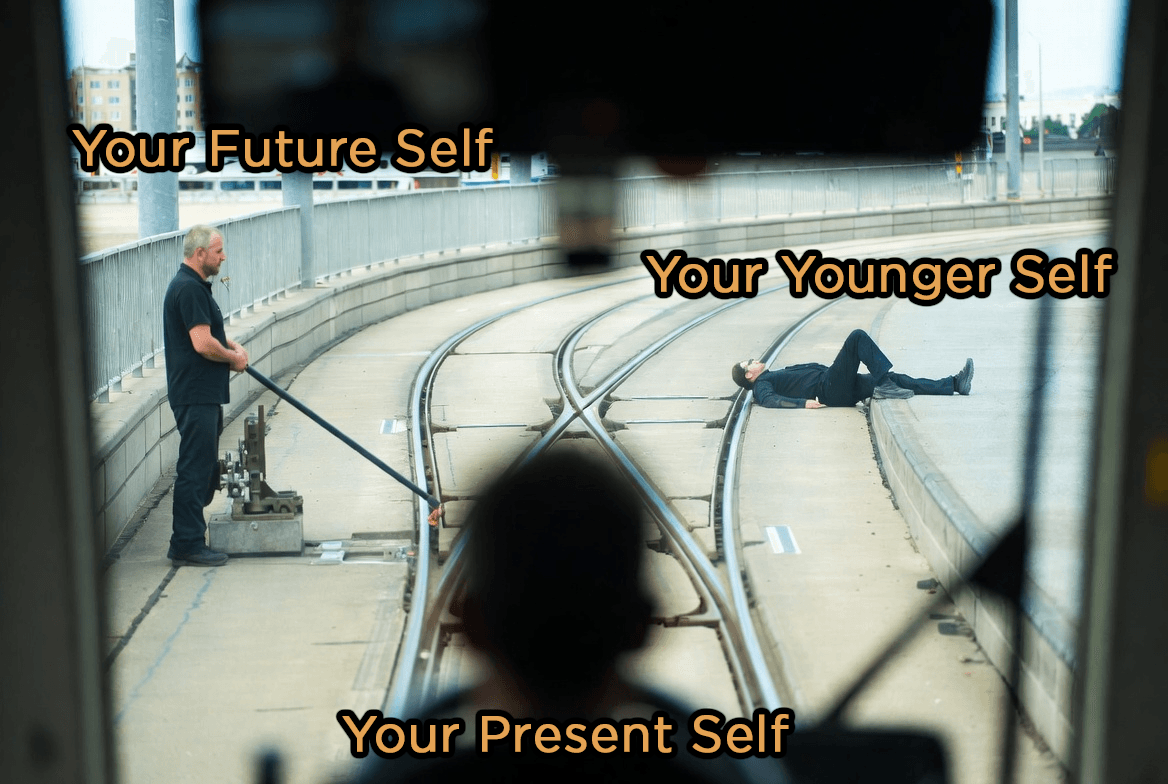
This meme reframes the classic “trolley problem” as an existential metaphor for self-development, showing the moral tension between preserving innocence, maintaining current stability, and realising potential futures.
The trolley problem: Traditionally, one must choose who to sacrifice to minimise harm. Here, the dilemma is internal.
Your younger self = innocence, past trauma, or the foundation of identity.
Your present self = agency and awareness, the decision-maker.
Your alternate future self = unrealised potential or the version of you that could exist if you make a different choice.
The “track switch” symbolises conscious choice: whether to preserve your past (avoid pain, nostalgia), protect your current stability (avoid change), or risk destroying parts of yourself to evolve into a new form (accept growth through loss).
Any choice creates loss. Saving your younger self implies stagnation; saving your alternate future means sacrificing comfort; indecision kills all versions slowly. This echoes Kierkegaard’s “anxiety of freedom” where the dread that accompanies choosing who to become.
The meme encapsulates Sartre’s concept of “bad faith” that refusing to choose is itself a choice. You cannot avoid shaping your future self, even by inaction.
One could argue the image romanticises self-destruction by implying progress requires “killing” parts of the self. In practice, Jungian psychology favours integration and the acknowledgement of every version of the self.
Every major decision involves metaphorically “sacrificing” one version of yourself. The wise path makes that sacrifice consciously and integrates who you have been with who you could become.