The Unfinished Self
Premature stabilisation of identity causes much of the failure seen in human development. Long before potential has finished organising, the system closes, favouring coherence over capacity. What looks like confusion or distraction is often the submerged phase of integration…
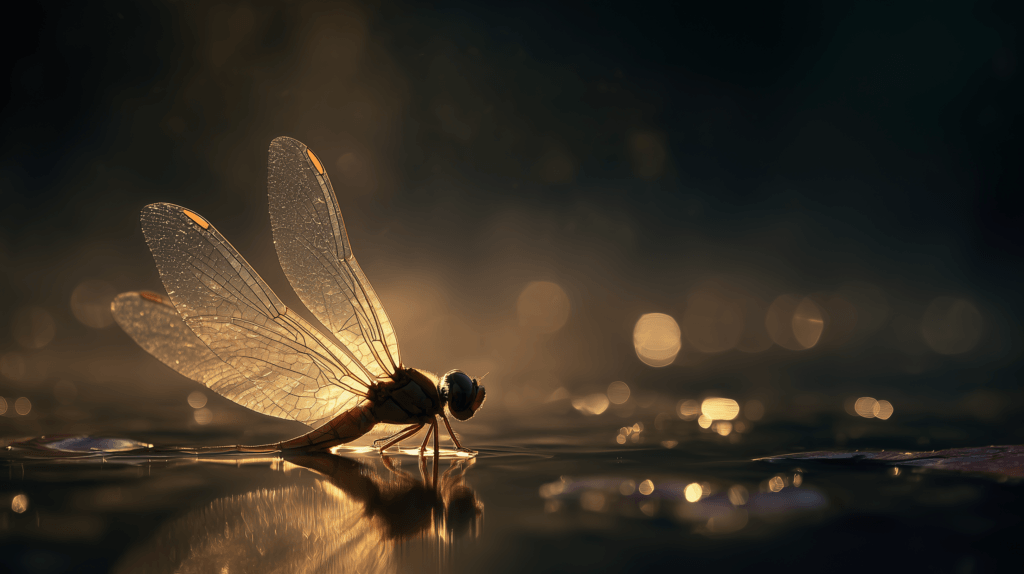
The dragonfly spends most of its life in a form that cannot fly. As a nymph, it develops underwater, constrained to a medium that actively prevents the behaviour it is ultimately built for. Its environment gives no hint of what it will become. There are no wings to practise with, no rehearsal for flight. Yet almost all meaningful development occurs here. Coordination, strength, sensory timing, and balance are assembled long before flight is possible. By the time emergence occurs, the work that matters has already been done.
Human development follows a comparable pattern, but it is routinely misread. Growth is expected to look like refinement, narrowing, and visible progress. Multiplying interests and internal inconsistency are treated as dysfunction whenever convergence and settlement are expected. Breadth is mistaken for distraction. Inner tension is mistaken for confusion. What is often a formative phase is labelled a problem to be fixed.
In the aquatic stage, the dragonfly is adapted to a dense environment. Movement is slow. Resistance is constant. Energy is spent simply getting from one place to another. Human equivalents are easy to recognise. Learning feels effortful. Different interests do not yet speak to each other. Skills remain isolated. Much of a person’s energy goes into holding themselves together while trying to function.
A polymath, someone who naturally spans multiple interests or domains, is often assumed to be a person who simply keeps learning more things. In practice, what separates polymathic expression from ordinary competence is how much of the self remains available and active.
Many people learn early on to divide themselves. Logic here, emotion over there. Strength in one context, softness hidden elsewhere. Certain traits are encouraged, while others are sidelined or suppressed because they feel inconvenient, impractical, or socially risky. Holding these separations in place takes effort. It consumes attention and limits how freely a person can think, act, and adapt.
This inner division places a ceiling on what someone can actually express. Ability exists, but it is not always accessible. Action requires constant inner negotiation. Decisions feel heavier than they need to be. Even genuine competence stays narrow because the person is organised around containment, preventing different parts from working together.
The submerged phase is where this inner architecture begins to come apart.
In biological terms, the dragonfly does not slowly turn into a flying creature by practising flight behaviours. Its body reorganises itself from the inside. Structures suited for one environment are broken down and rebuilt for another. This process is demanding and outwardly unimpressive. For long stretches, nothing visible seems to change.
Inner integration works the same way. It does not feel like progress because nothing new is being added. No fresh abilities appear. Instead, old constraints loosen. Contradictions are allowed to exist without being forced into a neat story. Direction becomes less obvious because the person is no longer optimising for a role or an outcome, but learning how their different inner parts can coexist without friction.
This phase produces little external signal. It is difficult to explain and impossible to measure. From the outside, a person may look stalled. From the inside, they often feel unfinished. Careers wobble. Social identities blur. Motivation comes and goes. The urge to resolve this discomfort is strong, and many people respond by settling on an identity that feels coherent enough to live with. It restores stability, but it also fixes them into a smaller version of themselves, one that functions, but cannot stretch much further without strain.
In the dragonfly’s life, emergence happens only once the internal work has reached a threshold. The nymph leaves the water, anchors itself, and undergoes a rapid transformation. This moment is exposed and irreversible. Once the wings harden, returning to the old environment is no longer possible.
When something similar happens in a person, it is not experienced as triumph. It is experienced as ease. The inner objections quieten. Parts of the self that once competed begin to cooperate. Skills developed in different areas suddenly reinforce each other. Decisions feel cleaner. Expression requires less effort because there is less inner resistance slowing it down.
The shift feels sudden because organisational change can escape notice until it becomes visible. Nothing new was added. What changed was how costly it felt to be oneself.
A woman in her forties, long established as a precise, reliable analyst, had always kept her painting, her poetry, her quiet philosophical obsessions in separate rooms. They were private indulgences that never quite belonged in her work. Then, over a couple of quiet years, the doors stopped closing properly. She let the fragments sit side by side without justification. One afternoon a client asked for a dry dataset to be made intuitively graspable. Without conscious effort, she translated the data into an intelligible structure, applied a painter’s sense of tone and balance, and incorporated questions she had previously avoided articulating. The result felt unforced. She noticed, almost as an afterthought, that no part of her had objected. The wings were simply there.
Once enough internal alignment is in place, behaviour reorganises naturally.
The dragonfly does not learn to fly. It reaches a point where nothing inside it prevents flight from happening.
Polymathy is uncommon because it requires living without a settled identity for longer than most people can tolerate. Many people stabilise while still shaped by the environment they know, ending the uncertainty that might otherwise carry them beyond it.
So when will you allow your wings to harden?