On the Examined Life
A belief can feel stable because the assumptions beneath it remain unexamined. When those assumptions are exposed, stability shifts because the limits of our access to reality become visible. The examined life does not remove uncertainty. It reveals how much of it is already being used.
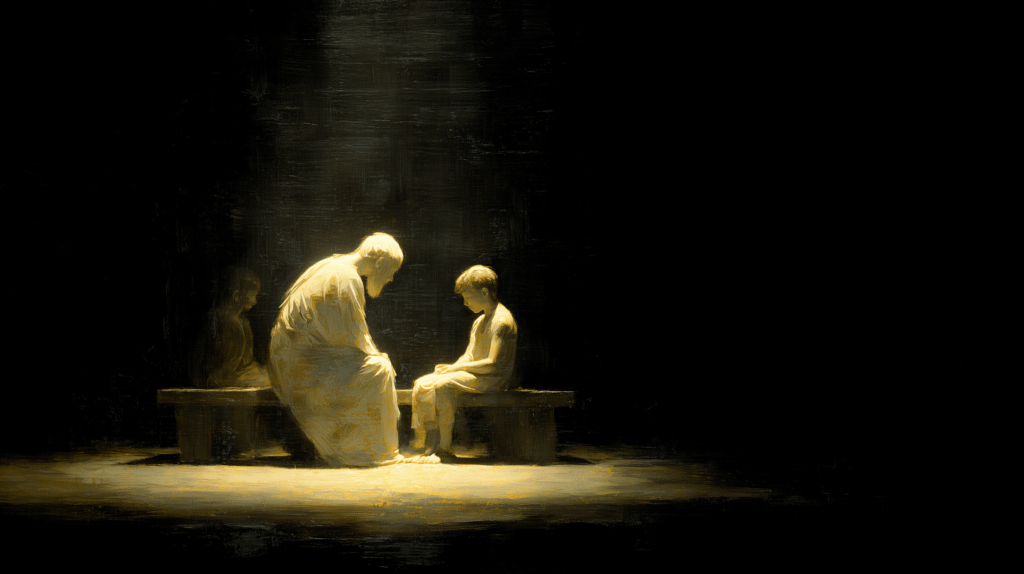
A discussion using the Socratic method, featuring Socrates.
Roman: I've been trying to examine everything I believe, reaching from surface claims down to the assumptions underneath them, because the belief itself often looks far more solid than the premises supporting it. Even something simple like trusting what I remember depends on several things already going right, like my memory being accurate, my interpretation at the time being sound, and the memory not having been reshaped by later emotion or later narrative. If those aren't examined, then I can feel justified while standing on something that has quietly shifted underneath me.
Socrates: Then your aim is to reach a point where what you rely on can account for itself all the way down, without leaning on assumptions that have never really been tested.
Roman: Yes. Because once you see how many beliefs inherit their strength from unexamined premises, it becomes hard to treat them as trustworthy just because they feel coherent. A belief can appear stable simply because the layers beneath it have been left untouched.
Socrates: And yet you still rely on memory constantly, even while admitting that memory may be inaccurate at several stages.
Roman: I have to. The issue isn't whether I use memory at all. The issue is how I use it. I don't want to treat it as sacred or infallible. I want to treat it as the best available account of what happened, while still recognising that 'best available' is not the same thing as fully established.
Socrates: Then what you act on is often the strongest available account, not the fully justified one.
Roman: Yes, although I'd still say there's an important difference between something being uncertain and something being arbitrary. Memory may be fallible, but it isn't random. It's constrained by experience, by context, by pattern, by whatever consistency remains in perception across time.
Socrates: Constrained uncertainty is still uncertainty.
Roman: It is, although not all uncertainty is equal. There's a difference between acting on something weak, vague, and speculative, and acting on something that is highly likely, repeatedly reinforced, and only technically incomplete. That distinction matters, because otherwise every gap gets treated as the same kind of problem.
Socrates: And while that gap remains, your decisions still rely on it.
Roman: Yes. Which is why I'm trying to reduce the number of hidden assumptions involved, or at least make them visible enough that I know what I'm leaning on when I act.
Socrates: Then your behaviour still depends on something you admit may be inaccurate.
Roman: Not entirely inaccurate. That matters. It isn't as though I'm saying memory is fiction. I'm saying it can contain distortion, and that distortion can become decisive if it goes unexamined. The point is not to discard memory. The point is to stop granting it more certainty than it has earned.
Socrates: Give me a case where the gap, as you call it, does not matter.
Roman: If I remember where I left my keys this morning, I can act on that without requiring absolute certainty about every detail surrounding the memory. I do not need to reconstruct the entire morning with precision in order to walk to the table where I'm fairly sure I left them.
Socrates: So you act because the memory is highly reliable.
Roman: Yes, because in cases like that the reliability is strong enough that the residual uncertainty is practically irrelevant. The cost of waiting for certainty is greater than the cost of acting on something highly likely to be true.
Socrates: Reliable, then, not certain.
Roman: Close enough to certainty for the action in question. And that matters too, because action is always scaled to consequence. Looking for keys is one kind of decision. Accusing someone, ending a relationship, or altering the course of your life based on a memory is another. The threshold should rise as the stakes rise.
Socrates: Then you are acting on what is sufficiently probable relative to the consequence of acting.
Roman: In practice, yes. Although I still wouldn't say that abandons truth. I'd say it acknowledges that access to truth comes in gradients, and behaviour has to operate before those gradients collapse into certainty.
Socrates: So now truth appears in degrees?
Roman: Access does. Not truth itself. What happened either happened or it didn't. What changes is how directly or reliably I can justify my belief about it. That distinction matters, because I'm not trying to make reality fuzzy. I'm trying to be honest about my relation to it.
Troy: Which means most of the time the real issue isn't whether reality is uncertain, but whether your access to it is.
Roman: Exactly. And that's why examination matters. If I don't separate those two, I'll start mistaking confidence for contact.
Socrates: And yet even in your example, you act before the matter is fully settled.
Roman: Because I have to. Action doesn't wait for epistemic completion. Life keeps moving while justification remains partial. That's the problem. You still have to behave, choose, infer, speak, and decide while much of what you rely on remains less than fully secured.
Socrates: Then action forces you beyond what you can fully justify.
Roman: Yes, although I'd put it more carefully. Action forces me to rely on beliefs that are not final, while still treating some as sufficient for the moment. Which means the examined life, if taken seriously, doesn't remove dependence. It changes the quality of dependence. It makes it visible, graded, and contestable.
Socrates: What makes that temporary, if each new situation introduces fresh uncertainty?
Roman: Temporary may be the wrong word if it implies that uncertainty disappears altogether. What I mean is that any specific uncertainty can be reduced, corrected, or replaced by a stronger account over time. The broader condition may remain, although that doesn't mean the work is pointless. It means the work remains iterative and open-ended.
Troy: So the uncertainty attached to this memory can shrink, even if the condition of having incomplete access never does.
Roman: Yes, and that distinction matters, because otherwise the argument turns fatalistic too quickly. If I can't eliminate all uncertainty, that doesn't mean I can't reduce serious error. And reducing serious error still changes how I live.
Socrates: Then perhaps you seek a way of living that reduces misalignment.
Roman: That's closer. Though even that irritates me, because part of me still wants full coherence, where what I believe, what is true, and how I act all sit inside the same structure without remainder. I can see that this may not be available, though I still resist treating that as an excuse to relax the standard.
Socrates: Why does that resistance remain?
Roman: Because the alternative feels too permissive. Once I admit that action must proceed under unresolved assumptions, there's a risk of letting too much through under the label of necessity. I don't want 'we must act under uncertainty' to become a blanket permission slip for laziness, bias, and narrative convenience.
Socrates: So your concern includes error and contamination. You fear that once the door is opened, poor thinking will enter under the same conditions as necessary approximation.
Roman: Yes. That is exactly it. Because approximation is unavoidable, and self-serving approximation is easy, and the distance between the two is often hidden by how reasonable it feels from the inside. That's why I'm not satisfied with merely acknowledging uncertainty. I want to know what kind of uncertainty I'm relying on, how much of it there is, and whether it is narrowing or widening.
Socrates: And your own example already shows that your action depends on what you judge sufficient, not on what has been made certain.
Roman: Yes, which means sufficiency is already doing more work in my life than I'd like to admit. I'd prefer truth to be the sole criterion. In practice, I'm constantly using a layered standard: truth where accessible, probability where necessary, caution where the stakes justify it, and revision where contradiction appears.
Troy: Which sounds like a managed mind that has abandoned the fantasy of purification.
Roman: It probably is. I just dislike how much management sounds like compromise, and how compromise sounds one step away from rationalisation.
Socrates: Would you ignore your memory entirely unless it were perfectly verified?
Roman: No, because that would make ordinary functioning impossible. At that point the attempt to avoid error would itself become irrational, because it would disable action more severely than the uncertainty ever would.
Socrates: Would you then rely only on what is fully certain, even if it prevented you from acting?
Roman: No. Because certainty, taken as a precondition for action, would collapse most of life into paralysis. Which means I can already see that complete justification cannot be the entry requirement for every decision, even if I still want it to be the ideal.
Socrates: Then your way of thinking already requires both what is strongly supported and what is not fully settled.
Roman: Yes. And I think that is the part I keep trying to outrun. I want a mind that does not need to borrow from the unproven in order to move. What I keep finding instead is that movement itself requires some reliance on what has not yet been fully secured.
Socrates: And when truth is incomplete?
Roman: Then I extend from what is strongest, while trying to remain aware that the extension is still an extension. That may be the best I can do without lying to myself about what level of justification I actually have.
Troy: So you mark the gap, accept its presence, and keep going.
Roman: Yes. It still feels unclean, though honesty may require accepting that clarity and action never fully fuse.
Socrates: Then perhaps the examined life does not deliver a state in which every belief is purified before use.
Roman: It may instead deliver a clearer sense of where the impurities are, which ones matter, and which ones I am quietly relying on every time I call something obvious.
Socrates: And is that not already an advance?
Roman: It is, although not the kind that flatters the mind. It doesn't end with certainty. It ends with better discrimination inside uncertainty, and with less room to confuse convenience with justification.